

Skip to content
Known
For  

PROJECT: CANONICAL

finding the lost through search


Pointing people to Jesus by surfacing biblical truth where the world is already searching for it.

A person alone at night, lit only by their phone, searching for answers.
The Need

A generation is searching for truth. The question is what they find.

Interest in faith is rising. Millions of people are actively looking for meaning, hope, and what the Bible actually says — and they are looking in the one place the Church has been slowest to show up.

A crowd of people of many ages, heads down, each looking into their own phone.

Search and AI have quietly replaced the pastor, the counselor, and the trusted friend as the first place people bring their hardest questions. It happens privately, at odd hours, with no one watching. And what comes back is generic, shallow, ad-driven, or sourced from a stranger on a forum.

This affects two groups at once. A smaller number are in real pain and need help immediately. A far larger number are simply seeking — asking about purpose, identity, forgiveness, marriage, and faith itself. Both deserve a truthful answer. Right now, both usually get something else.

The doors are already open. Every one of those searches is a person leaning toward the very thing the Church has been entrusted to carry.

Who is searching

Two kinds of searches. Both need the Church.

Millions are typing the questions they cannot say out loud. Some are reaching for hope. Some are in crisis. All of them are looking for truth.

The reach

Reaching for hope

BibleJesusGod
2019202120232025

Relative search interest · Source: Google Trends, United States

Interest in the Bible, Jesus, and God is at an all-time high, and still climbing. Every month, more than a million people search for what the Bible says. Moments like The Chosen and He Gets Us are drawing a generation back to the questions that matter. These are open doors.

The ache

In crisis

~20M

unique life-or-death searches each month, U.S., English, Google only

At the same time, tens of millions search from their lowest moments, asking about depression, identity, addiction, and despair. These are the questions people bring to a search bar because they feel they can bring them nowhere else.

If you’re in crisis, call or text 988 — the Suicide & Crisis Lifeline.

The patterns

Almost every one of them begins the same way.

Why am I…Why do I…How do I…

Three openings, asked in private, millions of times a month. Each one is a person describing their own life and asking someone to explain it.

The themes those questions fall into

Seeking faith & the Bible

“what does the Bible say about…” · “how do I pray” · “is God real”

Meaning & identity

“why am I here” · “what is my purpose” · “why do I feel empty”

Mental & emotional health

“why am I so anxious” · “why do I feel alone” · “how do I stop worrying”

Relationships

“how do I forgive” · “is my marriage over” · “how do I be a better dad”

Addiction

“how do I stop drinking” · “why can’t I quit” · “am I an addict”

The evidence

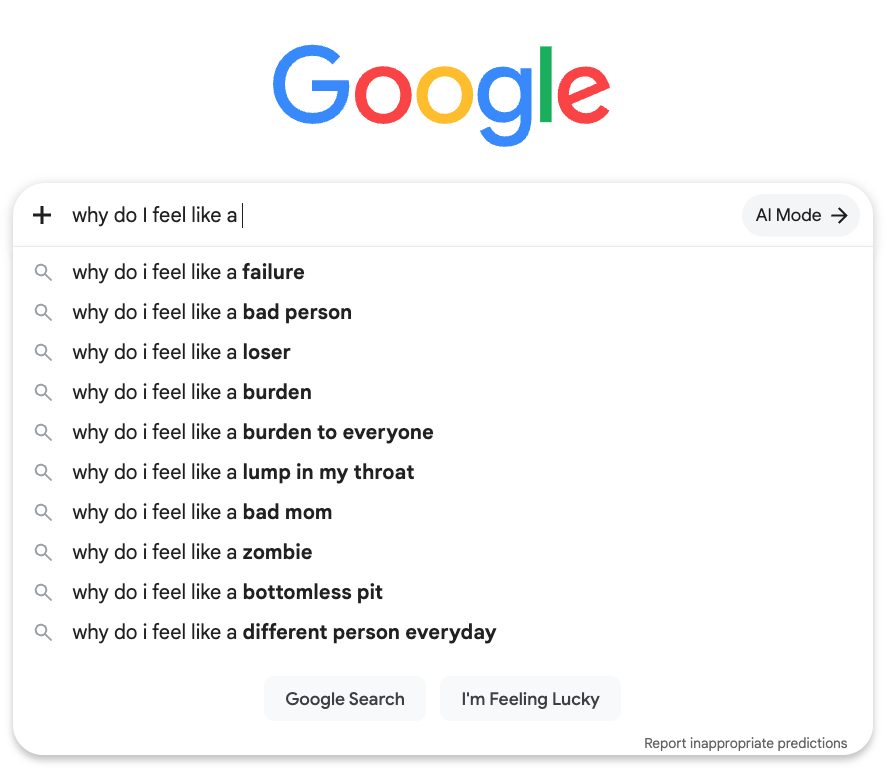
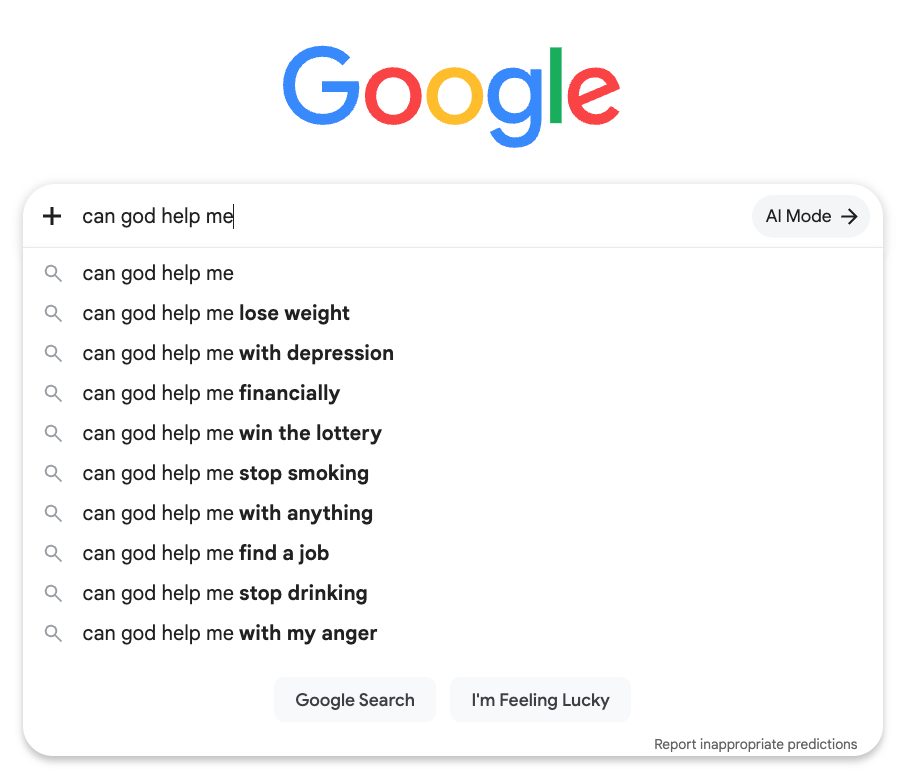
Google finishes the sentence for them.

The ache
Google autocomplete completing “why do I feel like a” with “failure”, “a burden”, “a loser”.
The reach
Google autocomplete completing “can god help me” with “with depression”, “financially”, “stop drinking”, “with my anger”.

Autocomplete is built from real searches, ranked by how often people type them. On the left, the ache. On the right, the reach: millions are already bringing God into the search bar.

The question is what they find when they do.

It already happened

Nothing happens by chance.

At his lowest, Forrest Frank went searching—on Google—and what he found led him to a church, and to hope. We don’t believe that was an accident. We believe it was God’s hand at work.

The opportunity for the Church is to be intentionally present where people are already searching, ready to welcome the next person who arrives at their lowest. It might be the next Forrest Frank. It might be someone whose impact will reach a whole generation, or only their own household. It might be a life saved. Every one of them is worth being ready for.
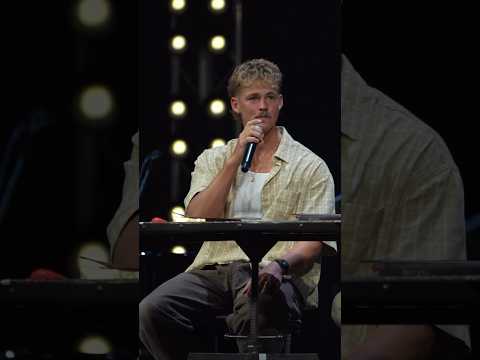
Forrest Frank sharing his testimony.Watch on YouTube
Forrest Frank’s testimony.
The Opportunity

One word, two meanings, one mission.

ca·non·i·cal

/kuh-NAA-nuh-kul/  ·  adjective

In search

The canonical page is the one the engine trusts.

When many pages say similar things, a search engine picks one as the authoritative source and treats the rest as duplicates. That chosen page is called the canonical. It is what gets shown, quoted, and fed to AI systems as the answer.

In Scripture

The canon is the trusted, authoritative Word.

The canon is what the Church recognized as true and reliable, the settled source we return to when the question actually matters. It has held authority for two thousand years without needing an algorithm’s permission.

Project: Canonical exists to make biblical truth the canonical answer — in both senses of the word.

The Solution

United churches, answering together.

A Spirit-led, church-aligned SEO and content strategy, coordinated across as many church websites as possible — so biblical answers rise to the top of search and AI results.

01

Spirit-led, church-aligned

Strategy begins in prayer and submits to the local church. We are not building a brand; we are serving the Body.

02

Coordinated across many sites

Instead of one site competing alone, churches contribute together so the collective authority is strong enough to rank.

03

Organized with modern tooling

AI and search technology handle the coordination, mapping, and measurement so that ministry effort goes to ministry.

04

Personalized to a real church

A searcher does not just find an answer. They find a church near them, with real people, ready to walk with them.

The Plan

How this actually gets built.

Phase 01

Timing & research

Identify the highest-need question sets, map what currently ranks, and establish the baseline we will measure against.

Phase 02

Domain strategy

Determine where truth should live — church sites, shared resources, and the canonical structure that ties them together.

Phase 03

Launch

Publish the first coordinated wave of answers with participating churches, built to biblical and editorial standard.

Phase 04

Monitoring

Track rankings, AI citations, and real connection — did a person actually reach a church, not just a page.

Phase 05

Management

Steward, update, and expand the body of work as questions, algorithms, and needs change.

The People

This takes an army of united churches.

Not one organization with a good idea. The Church, with a capital C, doing together what none of us can do alone.

Church leadership

Pastors and elders who say yes on behalf of their congregation.

Admins & website managers

The people who can actually publish and maintain the work.

Writers & truth speakers

Those who can say true things clearly and kindly.

YouTubers & creators

Reaching people where the question is asked out loud.

Counselors

Care that is competent as well as compassionate.

Teachers, men and women

Sound doctrine, plainly taught, for real situations.

Truth meets them. Truth points them home.

If you lead a church or a value-aligned nonprofit, there is room for you in this. Come help build it — contribute a site, a writer, a counselor, or a conversation.

Start a Conversation

The need is great and the competition is well funded.
The mission—and our God—is bigger than both.

If you’re in crisis, call or text 988 — the Suicide & Crisis Lifeline.